
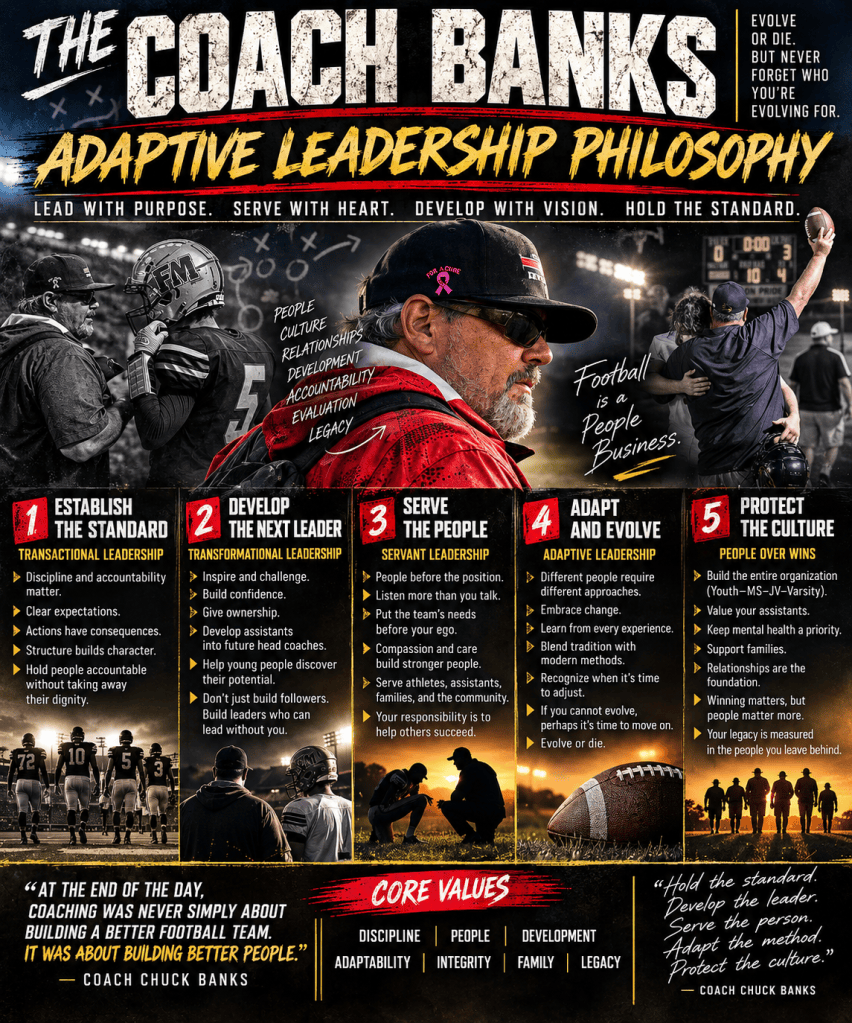
The Coach Banks Adaptive Leadership Philosophy
Lead with Purpose. Serve with Heart. Develop with Vision. Hold the Standard.
By Coach Chuck Banks
After more than two decades of coaching football, working in education, serving as an activities director, and having the opportunity to be both an assistant coach and a head coach, I’ve come to understand something about leadership.
There is no one-size-fits-all approach.
I’ve worked with transactional leaders.
I’ve worked with transformational leaders.
I’ve worked with coaches who believed in servant leadership.
And I’ve worked with some who believed that winning was the only thing that mattered.
I’ve learned something from all of them.
Some taught me what I wanted to become.
Others taught me exactly what I never wanted to become.
But every experience helped shape my own leadership philosophy.
I call it Adaptive Leadership — The Coach Banks Philosophy.
It’s a combination of transactional, transformational, and servant leadership, with one very important addition.
The ability and willingness to evolve.
Because here’s something I’ve learned over the years.
You cannot lead every young person the same way.
You cannot develop every assistant coach the same way.
And you certainly cannot expect the methods that worked 25 years ago to automatically work today.
The principles of good leadership should remain consistent.
But the methods we use to teach those principles must be capable of changing.
In my opinion, it’s pretty simple.
Evolve or die.
1. Transactional Leadership: Establish the Standard
I believe in discipline.
I believe in accountability.
I believe in structure.
And I believe young people need to understand that their actions have consequences.
Football is a tremendous teacher of those principles.
If you’re supposed to block the 3-technique and you don’t, there’s a pretty good chance somebody is going to find themselves in your quarterback’s lap.
That’s football.
If you don’t prepare, there are consequences.
If you don’t show up, there are consequences.
If you don’t take care of your responsibilities, somebody else has to carry the load.
That’s life.
But accountability must be fair, consistent, and purposeful.
Discipline should never be about embarrassing somebody or demonstrating how much power you possess.
It should be about teaching responsibility.
My philosophy: Hold people accountable without taking away their dignity.
2. Transformational Leadership: Develop the Next Leader
One of my greatest beliefs as a coach has always been that we should be developing the next generation of leaders.
I never wanted an assistant coach to remain an assistant simply because I needed somebody to run my drills.
I wanted him to grow.
I wanted him to challenge himself.
I wanted him to understand the entire program, not simply his position group.
I wanted him to have ownership.
And someday, if he wanted to become a head coach, I wanted him to be prepared.
The same goes for our athletes.
We shouldn’t simply be developing better football players.
We should be developing young men and women who can make decisions, solve problems, communicate, overcome adversity, and eventually lead others.
A successful leader doesn’t need everybody to depend on him forever.
A successful leader prepares people to succeed without him.
My philosophy: Don’t just build followers. Build leaders who can eventually lead without you.
3. Servant Leadership: People Before the Position
As I’ve gotten older, this philosophy has become increasingly important to me.
Early in my coaching career, I probably spent more time thinking about what people needed to do for the program.
Later, I began asking myself what I could do to help the people within the program.
That’s a significant change.
Servant leadership isn’t weakness.
It’s not allowing everybody to do whatever they want.
And it certainly doesn’t mean eliminating expectations.
It means recognizing that leadership is a responsibility, not a privilege.
Your athletes aren’t there to make you look important.
Your assistants aren’t there to stroke your ego.
And your program doesn’t exist to build your personal reputation.
You’re there to serve something bigger than yourself.
Sometimes that means having a difficult conversation.
Sometimes it means listening.
Sometimes it means putting your own interests aside.
Sometimes it means recognizing that a young person needs compassion more than criticism.
And sometimes it means admitting that you were wrong.
My philosophy: Never become so important in your own mind that you forget the people you’ve been entrusted to serve.
4. Adaptive Leadership: Evolve or Die
This is where I bring everything together.
There are situations when a coach needs to be transactional.
There are situations when a coach needs to be transformational.
And there are situations when servant leadership must take center stage.
A young athlete who repeatedly violates team expectations might need clear accountability.
An assistant coach who is ready for greater responsibility might need an opportunity to lead.
A player struggling with something at home might need somebody to listen rather than somebody to lecture.
Different situations.
Different needs.
Different approaches.
But the same core values.
That’s adaptive leadership.
It requires the ability to recognize what people need and adjust how you lead without abandoning what you believe.
It also requires humility.
Because sometimes the problem isn’t the players.
Sometimes the problem isn’t the assistants.
Sometimes the problem isn’t the parents.
Sometimes the problem is the person wearing the headset.
And if we aren’t willing to examine ourselves, how can we expect anybody else to improve?
My philosophy is that leadership should never stop evolving.
The day you believe you know everything is probably the day you need to start learning again.
5. Culture Over Ego
I’ve witnessed what happens when winning becomes more important than the people responsible for making winning possible.
I’ve seen what can happen when a coach becomes more concerned about his reputation than the development of his program.
I’ve seen assistants lose confidence.
I’ve seen lower-level programs treated as an afterthought.
And I’ve seen how a win-at-all-costs mentality can undermine the very culture a coach claims to be building.
I don’t believe in that philosophy.
Don’t misunderstand me.
I want to win.
I love winning.
I hate losing.
That competitive fire is part of who I am.
But winning should be the result of building something meaningful, not an excuse for tearing people down.
A championship is wonderful.
A district title is something to celebrate.
But if the process of getting there destroys relationships, devalues people, or damages the integrity of your organization, then what have you really accomplished?
My philosophy: Build a culture where winning matters, but people matter more.
6. Develop the Entire Organization
A football program isn’t simply 11 players standing on the field on Friday night.
It’s the varsity.
It’s the junior varsity.
It’s the freshmen.
It’s the middle school.
It’s the youth program.
It’s the assistant coaches.
It’s the managers.
It’s the families.
It’s the community.
Every level matters.
Every person has a role.
And every part of that organization deserves attention.
I believe a head coach should be the leader of the entire program, not simply the Friday night team.
You should be developing young coaches.
You should be mentoring lower-level staff.
You should be establishing continuity.
And you should be creating opportunities for everybody to grow.
If your entire organization falls apart when one coach leaves, perhaps you haven’t built the foundation you thought you had.
My philosophy: Build an organization that can sustain success long after you’ve handed over the keys.
7. Relationships Are the Foundation
This might be the most important part of my philosophy.
Relationships.
Football is a people business.
Education is a people business.
Leadership is a people business.
And if you cannot develop meaningful relationships with the people you’re leading, you’re going to struggle.
Young people need to know you care.
Assistant coaches need to know they’re valued.
Families need to know you have their children’s best interests at heart.
And communities need to understand that a coach is trying to develop more than a winning record.
Relationships don’t eliminate accountability.
They make accountability more meaningful.
A player who knows you care about him is more likely to understand that correction is intended to help him grow.
An assistant who knows you respect him is more likely to accept constructive criticism.
And a program built on trust is better equipped to survive adversity.
My philosophy: People will remember how you treated them long after they’ve forgotten the final score.
8. Protect the Mental Well-Being of Your People
This is something I’ve come to appreciate much more deeply later in my career.
We cannot continue talking about building positive cultures while ignoring the mental health of the people within those cultures.
That includes our athletes.
That includes our assistants.
And yes, that includes the head coach.
Leadership isn’t about pushing people until they break.
It’s about challenging people while giving them the support necessary to grow.
There is a difference between demanding excellence and creating an environment of fear.
There is a difference between accountability and humiliation.
And there is a difference between mental toughness and pretending that nobody ever struggles.
I want my players and coaches to know that making a mistake doesn’t make them failures.
I want them to understand that asking for help isn’t weakness.
And I want them to recognize that their value as human beings extends far beyond the football field.
My philosophy: Challenge people to become stronger without destroying the very people you’re trying to develop.
9. Family Must Remain Part of the Equation
I’ve learned this one through experience.
Our families sacrifice tremendously for this profession.
They share evenings.
Weekends.
Birthdays.
Holidays.
And countless hours that we’ll never get back.
I love football.
I always will.
But I’ve come to understand that no football program should become more important than the people waiting for you at home.
A healthy leader needs balance.
And a healthy organization should respect that balance.
We shouldn’t celebrate coaches simply because they spend every waking hour inside the football office.
We should celebrate coaches who develop successful programs while remaining good spouses, parents, and human beings.
My philosophy: Your family should never have to lose you so your football program can win. And…this may be a key reason why I am currently estranged from my oldest child Chelsey.
10. Legacy Is Measured in People
Someday every coach reaches the end.
The headset comes off.
The whistle gets put away.
The office gets cleaned out.
And somebody else takes over.
The games continue.
The stadium lights come back on.
And a new generation of athletes takes the field.
That’s the reality of coaching.
So what remains?
Hopefully, the relationships.
Hopefully, the lessons.
Hopefully, the young assistant who became a successful head coach.
Hopefully, the former player who became a tremendous father.
Hopefully, the young person who learned to persevere when life became difficult.
And hopefully, the people who remember that you genuinely cared about them.
I’ve never believed that our legacy should be measured entirely by the number of games we won.
Our legacy should be measured by the people we helped become better.
The Coach Banks Leadership Creed
I will lead with purpose, but never allow my ego to become bigger than the organization.
I will establish standards, but never use accountability as an excuse to humiliate.
I will demand effort, but recognize that mistakes are part of growth.
I will develop athletes, but never forget that I’m developing human beings first.
I will challenge my assistants, but also prepare them to become leaders themselves.
I will serve the people I lead, rather than expect them to serve my reputation.
I will value winning, but never place a victory above the integrity of my program.
I will embrace tradition, but never become so attached to the past that I refuse to evolve.
I will recognize that mental toughness includes knowing when to ask for help.
I will remember that my family matters more than any scoreboard.
And when my coaching career is finished, I hope the people I led remember more than the wins and losses.
I hope they remember that I cared.
Final Thoughts From This Old Ball Coach
If somebody asked me today what kind of leader I am, I wouldn’t give them just one of the traditional labels.
I believe in transactional accountability.
I believe in transformational development.
I believe in servant leadership.
And I believe in adapting to the needs of the people and situations in front of me.
I believe you can be demanding without being demeaning.
You can be compassionate without being soft.
You can be disciplined without being inflexible.
You can be competitive without sacrificing integrity.
And you can be a strong leader without needing to be the most important person in the room.
That’s the Coach Banks philosophy.
Hold the standard. Develop the leader. Serve the person. Adapt the method. Protect the culture.
Because at the end of the day, coaching was never simply about building a better football team.
It was about building better people.
And if we accomplish that, I believe we’ve done something worth remembering.
Evolve or die. But never forget who you’re evolving for.
— Coach Chuck Banks
The Coach Banks Adaptive Leadership Philosophy
Coaching Culture in Athletics

