
Part 4: Evolve or Die — The Changing Face of Leadership
Memoirs of an Old Ball Coach
Part 4: Evolve or Die — The Changing Face of Leadership
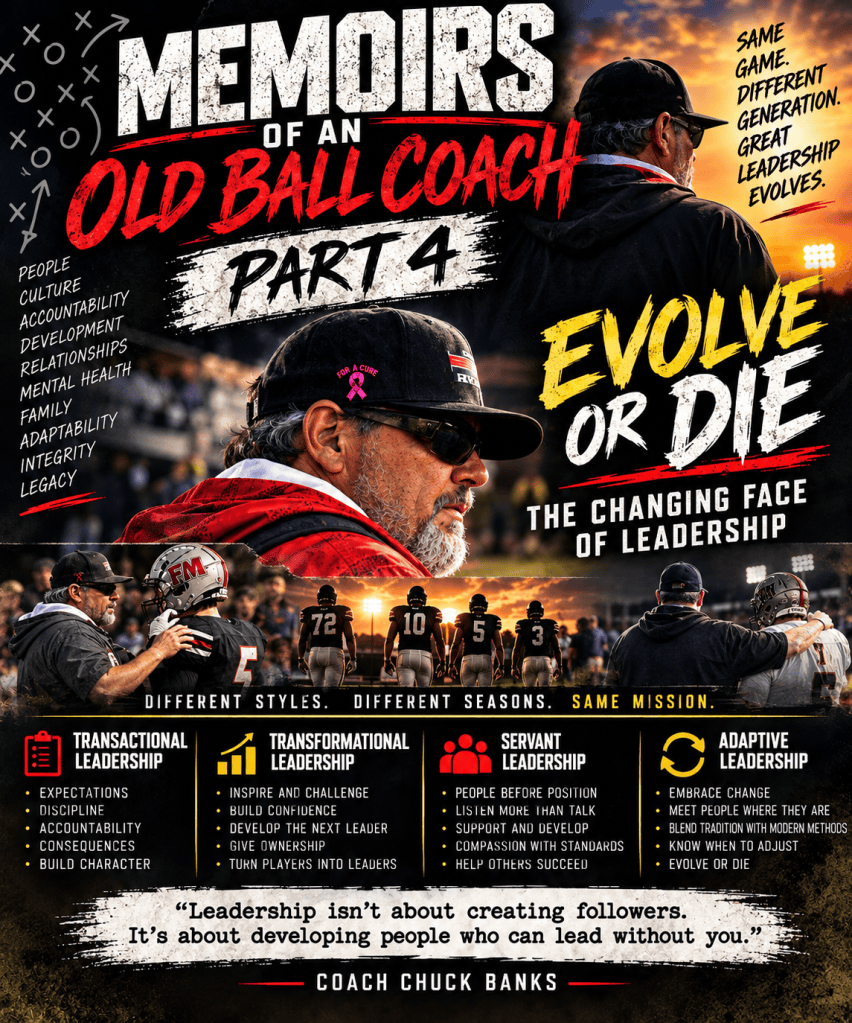
By Coach Chuck Banks
I’m probably going to ruffle a few more feathers with this one.
But after spending more than two decades coaching high school football, serving as an assistant, a head coach, and an activities director, I’ve come to understand something about leadership.
Just because somebody has the title of head coach doesn’t necessarily make them a great leader.
And just because somebody has been doing something for 30 years doesn’t mean they’ve been doing it right for 30 years.
There. I said it.
In the first three parts of this series, I’ve talked about the dark side of coaching, the sacrifices our families make, and the mental struggles that often go unseen.
Today, I want to talk about something that ties all three of those discussions together.
Leadership.
More specifically, the different leadership styles I’ve encountered throughout my career, how my own philosophy has evolved, and why I believe the future of coaching depends on our ability to change.
Because in this business, I’ve developed a pretty simple philosophy.
Evolve or die.
Now, I’m not talking about literally dying. I’m talking about the death of a program, the destruction of a positive culture, and the eventual loss of good people who simply get tired of working in an environment that refuses to grow.
And I’ve seen enough over the years to know that it happens.
The Old School: Do This Because I Said So
When I first entered coaching, the transactional leadership style was everywhere.
The philosophy was pretty straightforward.
You do this, you get that.
You don’t do this, there are consequences.
Run the play correctly, you get praised.
Miss your assignment, you’re running.
Show up late, you’re disciplined.
Question the coach, and you might find yourself standing next to him for the remainder of practice.
Now, before somebody starts throwing rocks at this old ball coach, let me make something clear.
There is absolutely a place for accountability, discipline, and consequences in athletics.
Kids need structure.
They need expectations.
They need to understand that their actions have consequences.
And sometimes they need somebody to tell them something they don’t particularly want to hear.
But here’s where I believe some of the old-school philosophy fell short.
It focused so much on compliance that it sometimes forgot about development.
We wanted kids to do exactly what we told them to do.
But were we teaching them why?
Were we teaching them to think?
Were we teaching them to become leaders themselves?
Or were we simply teaching them to follow orders?
There’s a difference.
And that difference matters.
The Transformational Leader: Building the Next Head Coach
As I continued through my career, I began to appreciate transformational leadership.
This philosophy made a lot of sense to me.
Instead of simply telling people what to do, you inspire them to become better.
You establish a vision.
You develop relationships.
You challenge people intellectually.
You give them ownership.
You help them discover abilities they might not even realize they possess.
And perhaps my favorite part?
You develop the next generation of leaders.
I’ve always believed that one of the greatest accomplishments a head coach can have is preparing an assistant to become a head coach.
Think about that for a minute.
If you’re truly committed to developing people, why wouldn’t you want your assistants to advance?
Why wouldn’t you want them to become successful?
Why wouldn’t you want them to take the lessons they’ve learned and build something special somewhere else?
Unfortunately, I’ve seen environments where assistants were treated more like employees who needed to stay in their place than future leaders who needed opportunities to grow.
That’s not leadership development.
That’s protecting your own position.
A great head coach shouldn’t be threatened by an intelligent assistant.
He should embrace him.
Challenge him.
Give him responsibilities.
Allow him to make decisions.
And yes, allow him to make mistakes.
Because someday that assistant might be standing on his own sideline with an entire community looking to him for answers.
If you’ve prepared him for that moment, you’ve accomplished something far more meaningful than winning another football game.
Servant Leadership: Where I Found Myself
As I’ve gotten older, I’ve found myself becoming more aligned with servant leadership.
And perhaps that’s one of the greatest changes I’ve experienced throughout my coaching career.
Early on, I was concerned with what I needed my players and assistants to do for the program.
Later in my career, I began asking a different question.
What can I do to help them become successful?
That’s a completely different mindset.
Servant leadership doesn’t mean you’re soft.
It doesn’t mean you allow players to do whatever they want.
It doesn’t mean there aren’t standards or expectations.
It means you recognize that your responsibility as a leader is to serve the people you’ve been entrusted to lead.
Sometimes that means listening instead of talking.
Sometimes that means putting your ego aside.
Sometimes that means recognizing that an assistant has a better idea than you do.
And sometimes that means realizing that the young man standing in front of you needs something far more important than another lecture about his footwork.
He needs somebody to believe in him.
I’ve come to believe that the greatest coaches aren’t necessarily the ones who know the most football.
They’re the ones who understand people.
Because you can draw up the greatest offensive scheme in the world.
You can run every coverage known to mankind.
You can have a playbook thicker than a telephone directory.
But if your players don’t trust you, and your assistants don’t feel valued, you’re going to struggle to build anything sustainable.
Football is a people business.
Always has been.
Always will be.
The Most Dangerous Leadership Style: Win at All Costs
Now comes the part that’s probably going to make a few people uncomfortable.
Throughout my years as an assistant football coach, I’ve experienced several different coaching philosophies.
Some were outstanding.
Some taught me lessons I still carry today.
Others taught me exactly what I never wanted to become.
And one philosophy in particular has always bothered me.
Win at all costs.
I’m not going to name names.
That’s not the purpose of this article.
But I’ve witnessed what can happen when winning becomes so important that everything else becomes secondary.
The reputation of the program.
The development of younger athletes.
The well-being of assistant coaches.
The relationships with families.
The culture you’ve supposedly spent years trying to establish.
All of it can become expendable in the pursuit of another victory.
And here’s the crazy part.
Sometimes these programs win.
Sometimes they win a lot.
They put trophies in cases.
They hang banners.
They receive recognition.
And from the outside, everything looks wonderful.
But what does the inside look like?
Are the assistants happy?
Are the younger coaches growing?
Are the lower levels being developed?
Are the kids enjoying their experience?
Are people afraid to speak up?
Is the head coach building an organization that can sustain success, or is he building something that revolves entirely around himself?
Those are questions worth asking.
Because I’ve learned that winning can sometimes hide a whole lot of dysfunction.
Your Lower Levels Matter
One of the biggest mistakes I believe a head coach can make is treating the lower levels as an afterthought.
Freshman football matters.
Junior varsity football matters.
Youth football matters.
Those coaches matter.
Those kids matter.
And those programs are the foundation of what you’re trying to build.
I’ve never understood the philosophy of sacrificing the development of younger athletes just to chase another varsity victory.
Yes, the varsity program is important.
Yes, Friday nights matter.
But what happens three years from now?
What happens when those younger players become seniors?
What happens when the coaches you’ve neglected decide they’ve had enough and move on?
A healthy program doesn’t begin on Friday night.
It begins long before those kids ever put on a varsity uniform.
And if your leadership philosophy doesn’t recognize that, then perhaps you need to reevaluate what you’re actually building.
Are you building a football program, or are you simply building a football team?
There’s a tremendous difference.
What About Your Assistants?
This is something I feel particularly strongly about.
Assistant coaches are the backbone of a football program.
They’re often the ones spending countless hours preparing position groups, breaking down film, developing relationships, and doing the work that never makes the newspaper.
Many have families.
Many have full-time jobs.
Many are making significant sacrifices for relatively little financial compensation.
And yet, in some environments, they’re treated as though their opinions don’t matter.
They’re expected to be loyal.
They’re expected to work.
They’re expected to agree.
And when something goes wrong, they may find themselves carrying blame for decisions they had very little control over.
That’s not how you develop leaders.
That’s how you lose them.
I’ve always believed that a head coach should be willing to listen to his assistants, even when what they’re saying isn’t what he wants to hear.
Especially then.
Because if you’re the smartest person in every meeting, you might need to find some different people to sit around your table.
Or maybe you need to stop talking long enough to realize how intelligent the people already sitting there actually are.
A successful coaching staff should be a collection of people working toward a common goal.
Not one person’s ego surrounded by a bunch of people afraid to disagree.
The Bridge Between Generations
Here’s where I believe coaching is at a crossroads.
There are some outstanding veteran coaches who have adapted beautifully to the changing world.
They’ve maintained their standards.
They’ve maintained their discipline.
They’ve maintained their expectations.
But they’ve also learned to communicate differently.
They understand that today’s young people aren’t necessarily worse than previous generations.
They’re different.
They’ve grown up in a different world.
Social media.
Instant communication.
Different family dynamics.
Different pressures.
Different expectations.
And whether we like it or not, those things matter.
You cannot always coach a 16-year-old in 2026 exactly the way somebody coached you in 1986.
Now, does that mean we abandon accountability?
Absolutely not.
Does it mean we lower our standards?
Hell no.
It means we find better ways to teach those standards.
We build relationships.
We explain expectations.
We hold kids accountable while helping them understand why accountability matters.
We don’t change our values. We change our methods when our methods stop working.
And that’s the bridge some coaches struggle to cross.
They become so attached to the way things used to be that they refuse to consider how things could be.
And if a coach absolutely refuses to evolve, refuses to listen, refuses to learn, and refuses to adapt, then perhaps it’s time for that coach to consider stepping away.
That’s not an insult.
That’s reality.
The game changes.
Young people change.
Society changes.
And leadership must continue to develop.
Evolve or die.
The Difference Between Fear and Respect
I’ve been around coaches who could walk into a room and everybody immediately became silent.
Sometimes that silence came from respect.
Other times it came from fear.
And there is a difference.
Fear might get you immediate compliance.
Respect builds long-term commitment.
Fear can make a player run through a wall because he’s afraid of what happens if he doesn’t.
Respect can make a player run through that same wall because he believes in the person asking him to.
Which one do you think creates a healthier culture?
Which one develops better future leaders?
Which one will that young man remember positively 20 years from now?
I know which one I’d choose.
And I wish I had understood that distinction as clearly early in my career as I do today.
Sometimes the Coach Needs Coaching
One thing I’ve learned over the years is that leadership development should never stop.
Not when you become a coordinator.
Not when you become a head coach.
Not when you win a district championship.
Not when you make the playoffs.
And certainly not when somebody starts calling you a legend.
We all have something to learn.
I’ve made leadership mistakes.
I’ve handled situations poorly.
I’ve said things I wish I could take back.
I’ve probably been too stubborn at times.
And there have been moments when my desire to win interfered with my ability to see the bigger picture.
That’s part of being human.
The important question isn’t whether you’ve made mistakes.
It’s whether you’ve learned from them.
Because a coach who refuses to acknowledge his own shortcomings is going to have a difficult time teaching young people how to overcome theirs.
What Will They Remember?
Someday the final whistle blows.
The headset comes off.
The keys to the football office get turned in.
And another coach takes your place.
It happens to all of us eventually.
The program continues.
The games continue.
The community finds somebody else to cheer for or criticize.
But the relationships remain.
And I’ve often wondered what former players and assistants will remember about the people who led them.
Will they remember a coach who cared about them?
Will they remember somebody who helped them grow?
Will they remember being encouraged to think, lead, and make decisions?
Or will they remember somebody who made them afraid to make mistakes?
Somebody who valued winning more than people?
Somebody who demanded loyalty but rarely demonstrated it in return?
Those are questions every coach should ask himself.
Because our legacy isn’t simply our win-loss record.
Our legacy is the people we leave behind.
Final Thoughts From This Old Ball Coach
When I look back on my career, I see pieces of all three leadership philosophies.
The transactional coach who believed in discipline and accountability.
The transformational coach who wanted to develop the next head coach.
And the servant leader who eventually realized that the greatest responsibility of leadership is helping other people succeed.
I don’t believe any coach fits perfectly into one category.
Leadership is complicated.
Different situations require different approaches.
There are times when you have to be firm.
Times when you have to inspire.
And times when you simply need to sit down, shut up, and listen.
But there is one thing I believe with every fiber of my being.
If the pursuit of winning causes you to devalue the people who make winning possible, you’ve already lost something far more important than a football game.
So to the young coaches entering this profession, keep learning.
To the veteran coaches, don’t be afraid to change.
To the head coaches, develop your assistants.
To the assistants, keep challenging yourselves.
To the administrators hiring leaders, look beyond the win-loss record.
Ask about culture.
Ask about staff development.
Ask about relationships.
Ask about the lower levels.
Ask what happens when adversity strikes.
And perhaps most importantly, ask whether the person you’re hiring understands that leadership is about more than being in charge.
Because the best leaders don’t simply create followers.
They create more leaders.
And when this old ball coach finally looks back on everything, I hope the people I coached with and the young men I coached remember something beyond the scoreboard.
I hope they remember somebody who cared.
Somebody who tried to help them become better.
Somebody who wasn’t perfect but was willing to learn.
And somebody who understood, perhaps a little more with each passing year, that football was never really just about football.
It was about people.
Always has been.
Always will be.
Until next time.
Evolve or die. But never forget the people you’re supposed to be leading.
— Coach Chuck Banks
Memoirs of an Old Ball Coach — Part 4
#MemoirsOfAnOldBallCoach #EvolveOrDie #LeadershipMatters #ServantLeadership #TransformationalLeadership #CoachingCulture #HighSchoolFootball #CoachingLife #DevelopLeaders #CultureOverEgo #FootballFamily #FridayNightLights #DogHouseTour #CCARadioBroadcastNetwork #CoachChuckBanks